WAEC Second Class Citizen by Buchi Emecheta is one of the most popular African prose texts used for Literature-in-English in WAEC. Every serious candidate offering Literature must study this novel very well because WAEC often sets essay and objective questions from it.
Unlike JAMB, WAEC requires deep explanation, including:
Story summary
Themes
Character analysis
Style and language
Lessons from the novel
This guide explains Second Class Citizen in simple English to help students understand it and perform well in the exam.
Read also: JAMB The Lekki Headmaster by Kabir Garba 2026/2027
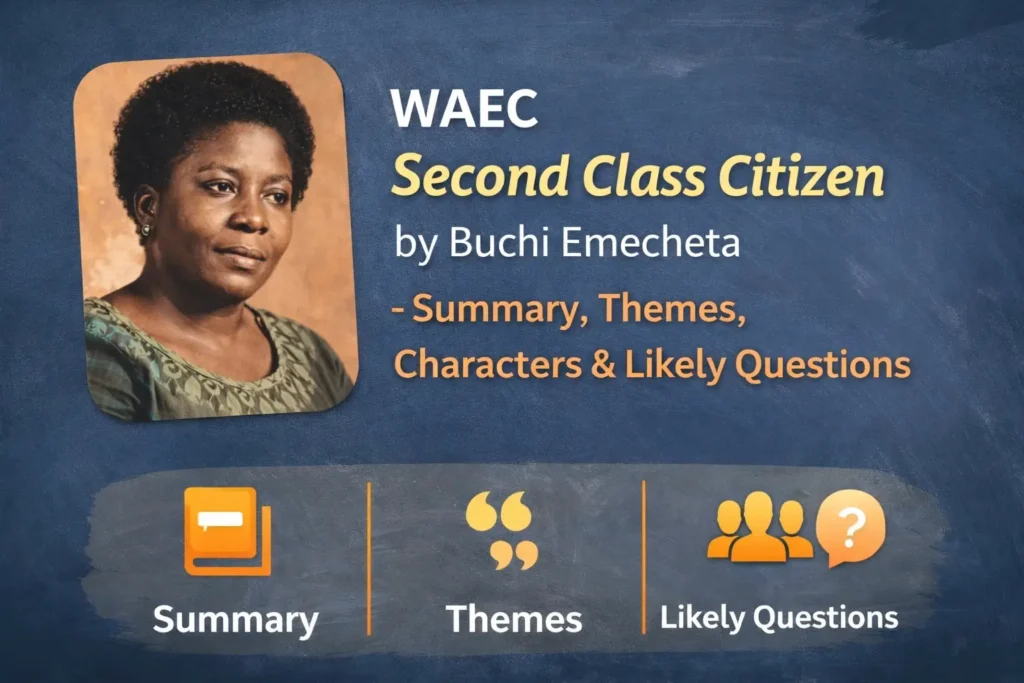
About Second Class Citizen by Buchi Emecheta
Second Class Citizen is a novel written by Buchi Emecheta, a famous Nigerian female writer. The novel talks about:
The suffering of women
Racism and discrimination
Marriage and oppression
Struggle for education
Life of African immigrants in Europe
The story is mainly about a young Nigerian woman named Adah and her struggle to survive in a male-dominated and racist society.
Summary of WAEC Second Class Citizen
Second Class Citizen tells the story of Adah, a Nigerian woman who dreams of getting education and becoming successful in life.
From childhood:
Adah is not valued because she is a girl
Her family prefers her brother’s education to hers
She struggles to go to school by herself
Later, Adah marries Francis, a weak and irresponsible man. She believes marriage will make her life better, but it makes it worse.
Adah travels to England with her husband, hoping for a better life. Instead, she faces:
Racism
Poverty
Domestic abuse
Discrimination
Humiliation
Francis:
Is lazy and selfish
Depends on Adah’s money
Treats her badly
Destroys her first novel manuscript
Does not support her dreams
Despite all this:
Adah continues to work
She takes care of her children
She refuses to give up her dream of becoming a writer
She finally decides to leave her abusive marriage
The novel ends with Adah choosing freedom, independence, and self-respect over suffering.
Plot Structure of Second Class Citizen
The story follows a chronological order:
Adah’s childhood in Nigeria
Her struggle for education
Her marriage to Francis
Their journey to England
Their life of suffering and poverty
Francis’s cruelty and irresponsibility
Adah’s decision to leave the marriage
Major Themes in WAEC Second Class Citizen
1. Feminism and Women’s Struggle
The novel shows:
How women are treated as inferior
How women are denied education
How women are expected to suffer in marriage
Adah represents the African woman who fights for her rights.
2. Racism and Discrimination
In England:
Blacks are treated as inferior
They are not allowed to rent good houses
They are insulted and humiliated
This shows that Adah is a second class citizen in a foreign land.
3. Marriage and Oppression
Adah’s marriage brings:
Pain
Suffering
Abuse
Frustration
Francis represents bad and irresponsible husbands.
4. Education and Self-Development
Adah believes:
Education is the key to freedom
Knowledge brings independence
A woman must not depend totally on a man
5. Poverty and Struggle
The family lives in:
Poor houses
Dirty environments
Constant lack of money
Yet Adah continues to struggle.
Major Characters in Second Class Citizen
1. Adah
The main character
Hardworking and determined
Loves education
Brave and patient
Represents African women fighting for freedom
2. Francis
Adah’s husband
Lazy and selfish
Cowardly and irresponsible
Jealous of Adah’s success
Represents male oppression
3. Adah’s Parents and Relatives
They:
Prefer boys to girls
Do not value female education
Represent traditional African mentality
Style and Language
Buchi Emecheta uses:
Simple English
Clear narration
Realistic storytelling
Emotional and touching language
The story is written in a way students can easily understand.
Lessons from WAEC Second Class Citizen
Education is the key to freedom
Women should fight for their rights
Not all marriages should be endured
Racism is evil and destructive
Self-respect is better than suffering
Hard work and determination bring success
Why WAEC Uses Second Class Citizen
WAEC chose this novel because:
It teaches strong moral lessons
It reflects African and global problems
It encourages critical thinking
It is rich in themes and characters
It improves students’ essay writing skills
Likely WAEC Questions from Second Class Citizen
Students should prepare for:
Discuss the character of Adah
Discuss the theme of racism
Write about marriage in the novel
Analyze the role of Francis
Explain the title “Second Class Citizen”
Discuss the theme of feminism
How to Pass WAEC Using This Novel
Read the novel at least twice
Study themes and characters
Practice essay questions
Learn key quotes and events
Understand the story, not cram
ALSO READ: JAMB Registration Form 2026/2027: Requirements, How to Apply
Conclusion
WAEC Second Class Citizen by Buchi Emecheta is a powerful novel about struggle, courage, and freedom. It teaches students to stand for their rights and never give up in life.
Any student who understands this book well will perform excellently in WAEC Literature.
![]JAMB Registration Form 2026/2027: Requirements, How to Apply & Updates](https://storyfolio.com.ng/wp-content/uploads/2026/01/JAMB-form-2026-211x150.webp "]JAMB Registration Form 2026/2027: Requirements, How to Apply & Updates")

